Discover why failure is your best teacher, how the build-break-fix loop creates expertise, and the art of balancing obsessive learning with sustainable growth.
Learning by Doing (and Breaking Things)
What followed the first programme was not a straight line of progress, but a series of loops - experiments, errors, insights, and questions. Once the spark had been lit, curiosity took over.
Each new programme became a small laboratory: a calculator here, a menu system there, a guessing game just for fun. A suggestion to build a chess game.
They were not built for grades or recognition. They were built to explore: What happens if I change this? What if I tried that instead?
The Goal: In those early days, the goal was not elegance. It was discovery. And discovery meant things broke.
Variables misbehaved. Loops ran forever. Programmes crashed or delivered nonsense. Sometimes they did nothing at all.
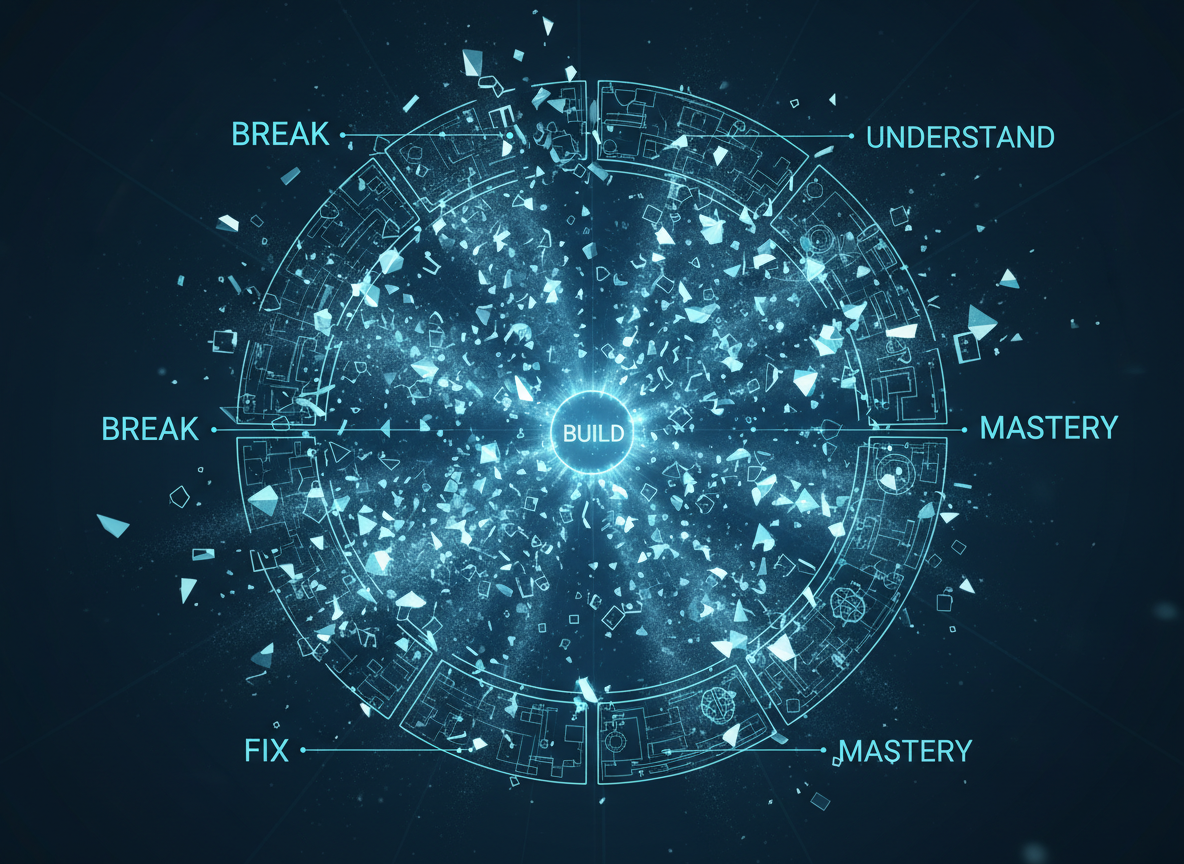
The Practice Loop: Build, Break, Fix, Understand
But these breakdowns were not discouraging - they were clues. Every bug was a signal. Every failed attempt pointed to something not yet understood. And that made them valuable.
Instant Feedback
Programming, unlike many subjects, provides instant feedback. You do not have to wait for someone to assess your progress. The machine responds. It either works - or it does not. And when it does not, you learn.
The Learning Rhythm
- Build: Write code with intention
- Break: Run it and watch it fail
- Fix: Debug and understand why
- Understand: Extract the principle
- Repeat: Apply to next challenge
This rhythm - build, break, fix, understand - became addictive. Hours would disappear without notice. The computer lab became a second home. Experiments multiplied.
Failures as Teachers
What made these failures valuable was their specificity. Unlike abstract concepts in textbooks, bugs revealed exactly where understanding broke down:
- Syntax errors: The rules of the language were not yet internalised
- Logic errors: The mental model of how the programme should work was incomplete
- Runtime errors: Edge cases and unexpected inputs were not considered
Each category of error taught different lessons. Each debugging session strengthened different mental muscles.
The Hidden Curriculum: Through this process, something deeper than programming was being learned: how to troubleshoot, how to reason about systems, how to persist through uncertainty.
The Paradox of Passionate Learning
But obsession, so intellectually rich, carried a subtle risk. That immersion began to compete with everything else.
When Passion Displaces Balance
Academic lectures felt slow. Coursework seemed distant. The formal structure of university study started to fade into the background. The computer lab offered immediate feedback, visible progress, and the satisfaction of creation. Traditional classes could not compete.
Eventually, the effects became clear: a few course subjects fell to the side - missed not out of apathy, but because something else had taken hold.
The Paradox: Passionate learning can become so immersive that it displaces the very foundations needed to support it. The fire that drives growth can also consume the structures that sustain it.
The Lesson of Balance
In hindsight, that phase required a lesson of its own. Expertise in one area means little if the broader system - grades, credentials, relationships, health - begins to collapse.
True mastery requires more than deep focus. It requires:
- Awareness: Recognising when passion becomes imbalance
- Structure: Building systems that protect what matters
- Perspective: Understanding that depth in one area requires breadth in life
The goal is not to dampen passion, but to channel it sustainably. To build guardrails that prevent obsessive learning from undermining long-term growth.
Sustainable Learning Practices
- Set time boundaries for deep work sessions
- Maintain non-negotiable commitments (health, relationships, responsibilities)
- Schedule regular breaks and perspective-taking
- Track progress across multiple life domains, not just skill acquisition
- Build accountability systems with others
Habits That Transfer Beyond Coding
The real value of that early learning period was not the specific programmes built or languages learned. It was the habits formed - habits that apply far beyond technology.
Breaking Problems into Steps
Programming forces decomposition. A complex programme cannot be written in one go. It must be broken into functions, each function into logic blocks, each block into individual lines.
This habit - breaking complexity into manageable steps - transfers directly to any problem-solving domain.
Testing Assumptions
Good programmers do not guess. They test. They write small experiments to verify assumptions before building larger systems. They seek feedback early and often.
This scientific mindset - hypothesis, experiment, observe, refine - is universal.
Persisting Through Uncertainty
Learning to code means spending significant time not knowing what to do next. Sitting with confusion. Searching for patterns. Trying different approaches.
Comfort with Discomfort: The ability to remain curious rather than anxious in the face of uncertainty is perhaps the most valuable transferable skill.
Celebrating Small Wins
Programming teaches you to notice progress in small increments. A function that finally works. A bug that finally makes sense. Each tiny victory is evidence of growth.
This habit - finding meaning in incremental progress - sustains motivation through long journeys.
Full Circle: Value Creation Through Craft
Years later, when reviewing complex system architectures or shaping user experiences, the memory of that quiet weekend in 1993 still lingers - not as nostalgia, but as a foundational moment.
Three pages of handwritten code, composed without access to a computer, represented more than a programming milestone. They marked the emergence of an approach to learning and building - one based not on formal instruction, but on staying with the problem, trusting internal logic, and making sense of complexity with limited tools.
The Deeper Lesson: It was possible to create something useful and earn from it. When that student handed over a small note of appreciation, it was not about the money. It was about what the gesture represented: that knowledge, when applied thoughtfully, could translate into impact and even income.
Building Careers from Curiosity
That realisation planted a deeper seed - one that would shape every step forward. It became clear that doing the work you enjoy, grounded in purpose and craftsmanship, could produce real outcomes - not only intellectual, but personal and professional.
Looking back, the experience was not just about solving a programming challenge. It was an introduction to:
- Systems thinking
- The creative power of logic
- The idea that careers can be built not only around skill, but around curiosity and contribution
Your "Hello, World" to Yourself
It was the first true "Hello, World" - not just a message to the machine, but to the self. And embedded in that message was something more enduring:
You can build value from within.
You can shape a future through what you love.
Permission to Try
Many people believe that coding "just isn't for them." They assume it requires a certain kind of mind, or a specific personality. But more often than not, it is the assumptions - not the skill itself - that get in the way.
The truth is, learning to code is not about being born technical. It is about giving yourself permission to try - patiently, consistently, and without fear of getting it wrong.
Growth Arrives Quietly: Growth in this field is rarely loud. It often arrives silently - one solved error at a time. And one day, something that once felt impossible will feel familiar. Not because it became easier - but because you grew stronger.
Practical Exercises: Developing Your Learning System
Exercise 6: Safe Breaking Space
Design a low-stakes experimental environment for your current learning. Where can you break things safely? What experiments can you run without consequences? Create your personal "lab."
Exercise 7: Feedback Loop Design
How can you get faster feedback on your learning? Identify 3 ways to create instant feedback loops for your skill development. What tools or practices would help?
Exercise 8: Passion Balance Audit
Assess your current learning intensity. Is your passion sustainable? What boundaries do you need? What else in your life needs attention? Create a balanced learning schedule.
Exercise 9: Habit Transfer Map
Identify 3 learning habits from one domain that could transfer to another. How do you break problems down? How do you test assumptions? How do you persist? Apply these patterns to a new challenge.
Exercise 10: Value Creation Plan
How can your developing skills create value for others? Identify one small project or contribution you could make right now, even with incomplete mastery. What would your "Hello, World" look like as an offering to someone else?
Chapter Summary: Learning is inherently awkward and frustrating - but that friction signals growth. The build-break-fix-understand loop accelerates mastery through immediate feedback. Passionate learning requires balance and sustainability. The habits formed through deliberate practice transfer across domains. Value emerges when skills meet curiosity and contribution.