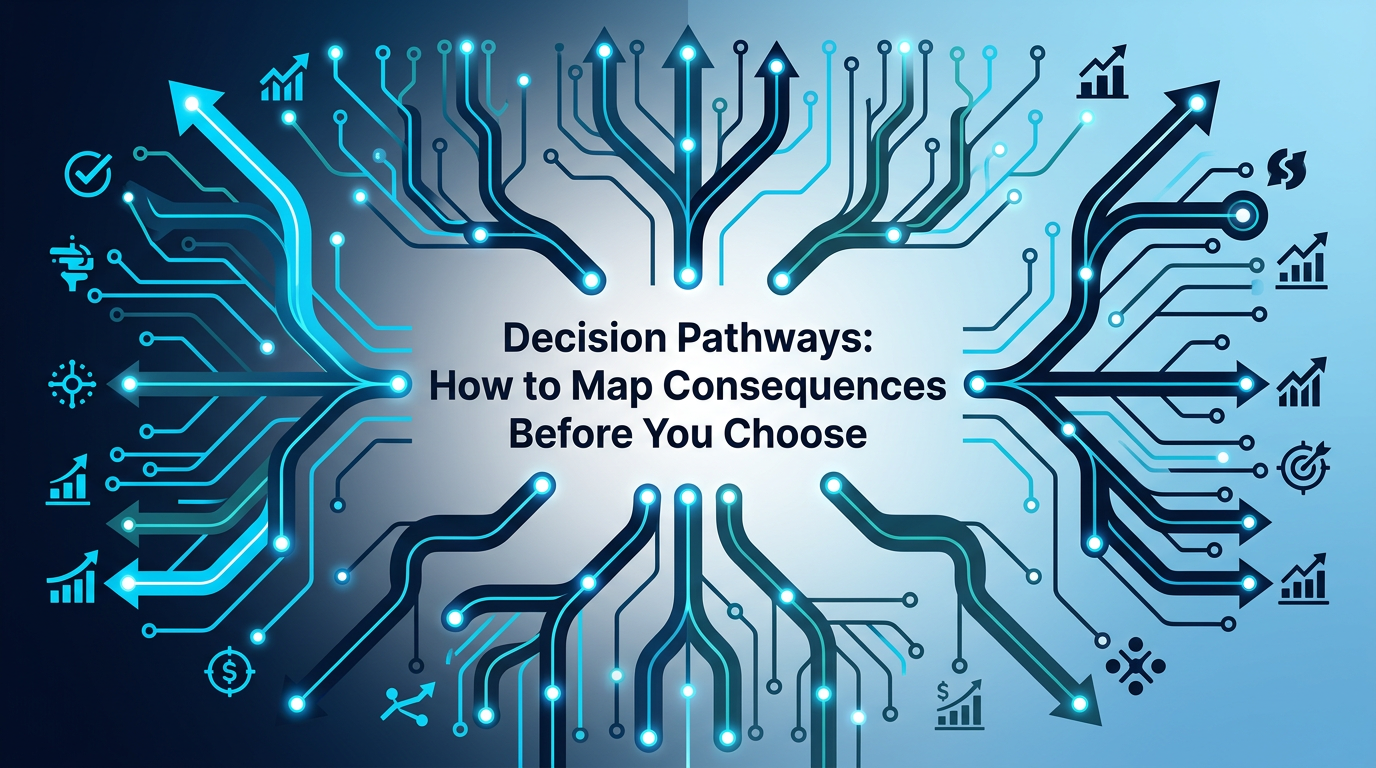
Every choice creates a pathway. Learn to see where each one leads before you commit.
The Hidden Cost of Blind Decisions
Most career regrets don't come from making the wrong decision. They come from making decisions without understanding where they lead.
You choose a job, a project, a skill to learn, a relationship to pursue. At that moment, it feels right—or at least acceptable. But years later, you look back and wonder: "How did I end up here?"
The answer is simple: You saw the decision. You missed the pathway.
Every choice you make is a fork in the road. One path leads somewhere. The other leads somewhere else. Both destinations exist whether you see them or not. The question isn't whether consequences will follow—it's whether you'll map them before they arrive.
Why Smart People Make Predictably Bad Decisions
Intelligence doesn't protect you from bad outcomes. In fact, smart people often make worse decisions because they overestimate their ability to course-correct later.
The Three Thinking Errors That Blind You
1. First-Order Thinking: You see the immediate consequence, not the cascade.
Example: "This job pays more" (first-order). What you miss: It also requires 60-hour weeks, leaves no time for skill development, and slowly makes you unemployable elsewhere (second and third-order effects).
2. Reversibility Blindness: You assume all decisions can be undone.
Some choices close pathways permanently. Taking that corporate job isn't just "trying something new." It's three years of skill development in a specific direction. It's a network built in one industry. It's a resumé that tells a story you may not want to tell forever.
Not all decisions are reversible. The ones that aren't deserve more scrutiny.
3. Isolated Decision-Making: You evaluate choices in a vacuum.
You ask: "Should I take this opportunity?" But the real question is: "Given all my other commitments, constraints, and goals—what pathway does this choice create, and where does it lead?"
Decisions don't exist in isolation. They exist in systems. And systems have downstream effects you can't see unless you deliberately look for them.
The Decision Pathway Framework
Before making any significant decision, work through this five-step process:
- Identify the Decision Point: What exactly are you deciding? Frame it clearly. "Should I take this job?" vs "Should I optimise for learning or income in the next 18 months?"
- Map All Pathways: Don't limit yourself to binary choices. What are ALL the possible routes? Often there are 5-7 viable options where you initially saw only 2.
- Trace Consequences (1st, 2nd, 3rd Order): For each pathway, ask: What happens immediately? What happens because of that? What happens because of that? Go at least three levels deep.
- Evaluate Reversibility: Can you undo this choice? At what cost? What pathways does it close permanently?
- Choose the Pathway, Not the Outcome: You're not choosing what happens tomorrow. You're choosing which version of yourself you'll become five years from now.
Real Example: The Two-Path Problem
Let's take a common decision: You're offered a senior role at an established company, and you're also considering starting a side project that could become a business.
Most people evaluate this way:
Corporate role: Stable income, impressive title, structured environment.
Side project: Uncertain income, full ownership, flexible schedule.
Then they pick based on risk tolerance and immediate needs. This is first-order thinking.
Mapping the Full Pathways
Pathway A: Corporate Senior Role
- Year 1: High income, learn corporate systems, build professional network
- Year 3: Expertise in specific domain, strong credentials, golden handcuffs forming
- Year 5: Senior position, high income, but skills highly specialized. Leaving becomes expensive. Autonomy decreases.
- Year 10: Expert in narrow field. High salary makes risk-taking difficult. Identity tied to company/role. Hard to start fresh.
Pathway B: Side Project → Business
- Year 1: Uncertain income, steep learning curve, complete autonomy. Build in public, direct market feedback.
- Year 3: Failed projects + learnings. Generalist skill set. Small but real revenue. Resilience developed.
- Year 5: Sustainable business or pivot to employment with unique perspective. Network of builders. Comfort with uncertainty.
- Year 10: Multiple ventures attempted. Deep understanding of value creation. Transferable skills. Optionality preserved.
Notice what's different? We're not comparing "corporate vs startup." We're comparing who you become and what options remain available five and ten years down each path.
Neither pathway is "better." They lead to different places. The question is: which destination do you actually want?
The Compound Nature of Decisions
Here's what makes decision pathways so critical: small decisions compound.
Saying yes to that coffee chat leads to a conversation. The conversation leads to an introduction. The introduction leads to an opportunity. That opportunity leads to a skill you develop. That skill leads to the next opportunity. Five years later, your entire career trajectory traces back to that single coffee.
But you didn't see the pathway when you made the decision. You just thought: "Sure, I'll grab coffee."
The 1% Rule of Pathway Deviation
Imagine two paths diverging at a 1-degree angle. After one metre, they're barely separated. After 100 metres, they're nearly two metres apart. After 10 kilometres, they're 175 metres apart—different neighbourhoods.
Your decisions work the same way. A small choice—working 30 minutes extra per day, reading instead of scrolling, choosing depth over breadth—creates a tiny deviation. But compounded over months and years, it leads somewhere completely different.
This is why mapping consequences matters. The immediate effect looks negligible. The long-term destination is radically different.
How to Map Consequences: A Practical Method
Step 1: Define the Actual Decision
Most people frame decisions poorly. "Should I take this job?" is vague. Better: "Should I optimise for income, learning, autonomy, or credentials in the next 24 months?"
Clarity in framing leads to clarity in evaluation.
Step 2: Identify All Viable Pathways
You almost always have more options than you initially see. Write them all down:
- • Take the job as offered
- • Negotiate different terms (remote, part-time, project-based)
- • Decline and stay put
- • Decline and look for alternatives
- • Take it temporarily whilst building an exit
- • Counter-offer to current employer
Most people see two options: yes or no. In reality, there are usually five to seven.
Step 3: Map Consequences at Three Time Horizons
For each pathway, trace consequences at:
6 months: What immediate effects occur?
2 years: What second-order effects emerge?
5 years: What version of yourself exists at this point?
Don't just think about outcomes. Think about skills developed, relationships built, options preserved or destroyed, identity shifts, and what becomes easier or harder from that position.
Step 4: Evaluate Reversibility and Opportunity Cost
Ask: Can I undo this decision? At what cost?
Some choices are reversible (taking a contract role for six months). Others are effectively permanent (moving countries, starting a family, spending years in a specialized field).
Irreversible decisions deserve deeper analysis. They're not just choosing what you'll do—they're choosing what you'll never do.
Step 5: Choose the Pathway That Aligns With Your Actual Goals
This is where most people fail. They map the pathways correctly, then choose based on what they should want rather than what they actually want.
If you want autonomy, don't choose the path that maximises income at the cost of freedom—even if it "looks better" to others.
If you want deep expertise, don't choose the generalist path—even if it feels safer.
The pathway you choose should lead to the future you want to inhabit, not the one you think you're supposed to want.
Key Principles for Decision Pathways
- Every decision creates a pathway, not just an outcome. Map where each path leads before committing.
- Small decisions compound over time. A 1-degree deviation today becomes a completely different destination in five years.
- Think in three time horizons: immediate (6 months), medium-term (2 years), long-term (5+ years).
- Not all decisions are reversible. Irreversible choices deserve deeper scrutiny.
- Evaluate second and third-order consequences, not just immediate effects.
- Don't choose based on what looks good. Choose based on where the pathway actually leads.
- Your career is the sum of consequences compounded over time, not the sum of individual decisions.
The Meta-Skill: Learning to See Pathways
Mapping decision pathways isn't something you do once. It's a skill you develop over time.
The more you practise, the faster you see consequences. What once took hours of deliberate analysis becomes intuitive. You start noticing second-order effects automatically. You spot reversibility without thinking. You see compound effects before they materialise.
This is systems thinking applied to your life. And like any skill, it improves with deliberate practise.
How to Practise
1. Post-Decision Analysis: After making decisions, write down what you expected to happen and what actually happened. Where did your predictions fail? What consequences did you miss?
2. Reverse Engineer Outcomes: Look at where you are now. Trace backwards. What decisions led here? What pathways were created? What alternatives existed that you didn't see at the time?
3. Study Others' Pathways: Read biographies. Not for inspiration, but for pathway analysis. What decisions created which outcomes? What consequences were predictable? What were surprising?
4. Map Small Decisions: Practise on low-stakes choices. Should I attend this event? Read this book? Take this call? Map the pathways. See what happens. Build the muscle.
Over time, you'll develop an intuition for pathways. You'll start seeing consequences before they arrive. And that changes everything.
Final Thoughts: The Power of Seeing What Others Miss
Most people stumble through their careers making decisions based on how things feel in the moment. They optimise for comfort, status, or immediate reward. Then they wonder why they end up somewhere they never intended to go.
The difference between a deliberate career and an accidental one isn't talent, intelligence, or luck. It's the ability to see pathways where others see only choices.
When you learn to map consequences, you stop reacting to opportunities and start designing outcomes. You stop asking "What should I do?" and start asking "Where does this lead, and is that where I want to go?"
It's a simple shift. But it changes everything.
Because your career—and your life—is not the sum of your decisions. It's the sum of consequences, compounded over time.
The question is: Are you mapping them before they arrive?
Essential Books for Decision-Making and Systems Thinking
Deepen your understanding of decision pathways, systems thinking, and building antifragile strategies with these highly-rated books:

Thinking in Systems
Donella Meadows' essential primer on systems thinking. Learn to see the world as interconnected systems and understand how to solve complex problems by addressing root causes, not symptoms.
View on Amazon
Principles: Life and Work
#1 New York Times bestseller from Ray Dalio. A systematic approach to decision-making through radical truth and transparency. Learn to systemise life, management, and investing into clear principles.
View on Amazon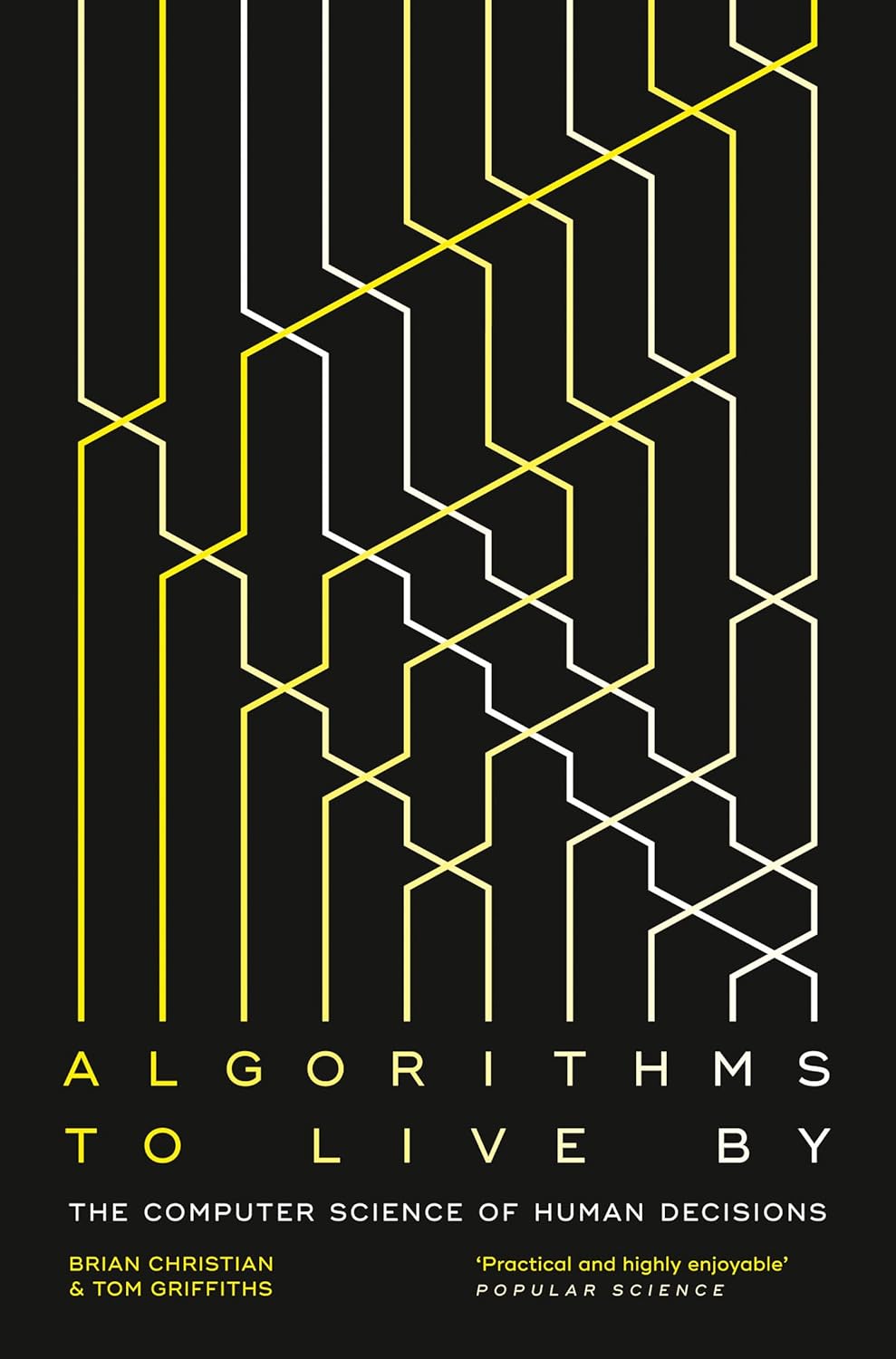
Algorithms to Live By
Apply computer science algorithms to everyday decisions. From finding a spouse to organising your inbox, discover practical frameworks for solving common decision-making problems.
View on Amazon
Antifragile
Nassim Taleb's blueprint for thriving in uncertainty. Learn to build systems and make decisions that benefit from chaos, disorder, and volatility rather than being harmed by them.
View on AmazonMaster Systems Thinking for Better Decisions
Decision pathway mapping is one aspect of systems thinking—a meta-skill that transforms how you approach complex problems, design your career, and build mental models that last.
Wired for Innovation

Learn how to build robust mental frameworks for understanding complex systems, making better decisions, and seeing second-order consequences before they materialise.
Get the BookInnovation Workbooks

Structured exercises to practise decision mapping, systems thinking, and pathway analysis. Build the muscle through deliberate practise.
Explore WorkbooksMarket Research in the Age of AI

Apply systems thinking to business decisions. Evaluate opportunities, map competitive landscapes, and make strategic choices with confidence.
Get the Guide