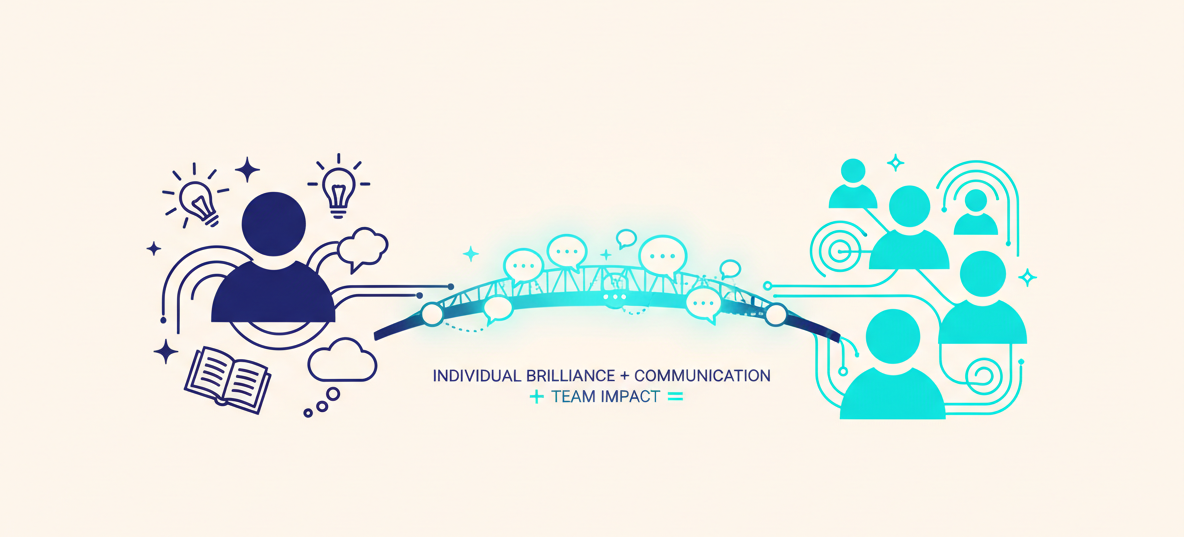
Personal mindset is just the beginning. Discover how invisible traits transform when working with others - and why communication, humility, and continuous learning separate long-term innovators from short-term achievers.
In Part 1, we explored three invisible traits that shape how you think and work alone: curiosity over comfort, debugging mindset, and clarity over cleverness.
But innovation does not happen in isolation.
The real test of mindset isn't just how you solve problems by yourself - it's how you think, communicate, and grow when working with others. Because the most impactful work always involves collaboration, shared understanding, and collective growth.
Beyond any tool, any title, or any trend - what truly lasts is your mindset. The way you think. The way you question. The way you grow with others.
Confidence with Humility
Confidence is essential in any field. It enables people to defend ideas, lead conversations, troubleshoot under pressure, and make decisions others depend on.
Without confidence, progress stalls.
But when confidence stands alone - unaccompanied by humility - it quickly becomes a barrier rather than a bridge.
The Dangerous Illusion of Certainty
In a world where change is constant, where no one knows everything, and where new challenges often appear without warning, the most powerful companion to confidence is humility.
It's tempting to equate expertise with certainty. After years spent mastering a craft, refining techniques, or solving complex problems, it's easy to develop quiet assumptions:
- "I've seen this before."
- "I know what works."
- "This is how it should be done."
Often, that experience serves well - until the moment it doesn't.
When Experience Meets New Perspectives
During a project review, a newer colleague suggests a cleaner, more efficient approach. The instinct of a senior team member might be to defend the original method. After all, experience informed it.
But when the suggestion is explored openly, it reveals a better path forward.
In that moment, the real barrier isn't lack of skill. It's the refusal to listen.
How Humility Sharpens Confidence
Humility doesn't weaken confidence. It sharpens it.
- Confidence proposes ideas with conviction
- Humility invites those ideas to be tested and improved
- Confidence defends what is known
- Humility remains open to what is unknown
The most resilient thinkers, builders, and leaders are not those who claim certainty at every turn. They are those who carry both conviction and curiosity into every room.
Transforming Team Dynamics
This balance does more than refine personal growth. It transforms group dynamics:
- Teams collaborate more openly
- New voices are heard
- Ideas are debated, not defended
- Growth happens across experience levels, not just at the top
Over time, this builds more than projects. It builds trust - and the environments where real innovation can happen.
From Keyboard to Conversation
There's a persistent myth in the world of technology: the idea that the best developers work alone - deeply immersed in code, far from meetings, communicating only through polished software and clever solutions.
It's an attractive image. But it's incomplete.
While technical skill is central to building solutions, much of the real work happens away from the keyboard - through conversation.
The Real Challenge
In professional environments, the true challenge isn't just to write clean, functional code. It's to ensure that what's built aligns with:
- Business goals
- User needs
- System constraints
- Evolving team dynamics
And that alignment doesn't emerge from code alone. It emerges through dialogue, negotiation, and shared understanding.
What Effective Creators Must Do
Whether building software, designing processes, or leading projects, effective creators must often:
- Translate abstract goals into clear action steps
- Explain technical trade-offs to non-technical stakeholders
- Collaborate across diverse teams - designers, analysts, users
- Justify design decisions in reviews
- Listen for needs hidden beneath what is said
These are not secondary skills. They are foundational.
Early in a journey, it's easy to believe that technical ability is enough - write excellent code, and success will follow. But experience reveals a deeper truth: Projects rarely fail because code doesn't work. They fail because communication does.
When Communication Fails
- A beautifully crafted feature that solves the wrong problem is still a failure
- A scalable system that ignores user feedback becomes irrelevant
- A technical breakthrough that no one understands remains unused
The bridge between intention and outcome isn't just built with syntax - it's built with speech, documentation, and shared meaning.
What Stronger Communication Creates
Exceptional developers - and exceptional creators in any field - recognise this. They don't just explain what they built. They explain why. They surface assumptions early. They invite questions. They engage in feedback loops that strengthen solutions before they're deployed.
In practical terms, stronger communication leads to:
- Fewer misunderstandings
- Clearer project goals
- More realistic expectations
- Healthier, more resilient teams
Learning Never Ends
In every fast-moving field - from technology to science to entrepreneurship - one reality stands firm: the ground is always shifting.
Tools evolve. Methods change. Entire paradigms are reimagined in a matter of months.
To some, this pace is exhausting. But to those who thrive, it's energising. Because once the illusion of mastery fades, something more enduring emerges: a mindset built on continuous learning.
The Illusion of "Done"
There's no final level. No permanent arrival. Every solved problem reveals new questions. Every milestone becomes a stepping stone to something more complex - or more elegant.
In the early years, it's tempting to believe that learning is a phase. That once enough is known - once a project is shipped, the certificate earned, or the title awarded - the hard part is over.
But that belief rarely survives contact with the real world.
The reality is simple: Learning is the job. And not just when it's assigned.
How Continuous Learners Think
The most effective builders, developers, and creators learn when no one asks them to. They:
- Follow their curiosity into unfamiliar terrain
- Build messy side projects that don't need to be polished - only real
- Read, watch, explore, and fail - not chasing perfection, but training adaptability
Sometimes that learning is structured - a book, a course, a certification. Other times, it's informal - debugging an unexpected issue, experimenting with a new technique, or integrating a new tool over a weekend.
In both cases, the reward isn't just knowledge. It's momentum.
Why Momentum Compounds
Momentum compounds over time - becoming the reason some professionals grow rapidly while others plateau. Not because of raw intelligence, but because of mindset.
The ones who continue to learn:
- Stay relevant in fast-moving industries
- Build confidence in ambiguity
- Expand their value across disciplines
- Reinvent themselves when needed
- Remain energised
In any creative field, learning is never optional. But when it becomes a habit - something practised, embraced, and even enjoyed - it stops feeling like effort.
It starts feeling like evolution.
Building the Mind Behind the Code
Technologies will evolve. Tools will be replaced. Strategies and frameworks will rise and fall.
But what endures - what ultimately shapes how you think, build, and lead - is your mindset.
The mindset that defines growth is not about how much you know. It's about how you respond to the unknown:
- The curiosity that drives you to explore beyond the obvious
- The awareness that sees connections between systems, ideas, and people
- The calm that rises when things break - and the patience to trace them back to clarity
- The humility to keep learning, even when experience tempts you to stop
- The communication skills that turn individual brilliance into collective impact
This way of thinking isn't something that arrives all at once. It's forged gradually - through late-night problem-solving, through moments of doubt, through collaboration and reflection, and through the quiet persistence of asking: Why? again and again.
Beyond any tool, any title, or any trend - this is what truly lasts. The way you think. The way you question. The way you grow.
Invest deliberately in this architecture of the mind. Because in the long run, it's not just your skills or your achievements that scale. It's your mindset.
Put It Into Practice: From Solo to Team
These traits - humility, communication, and continuous learning - transform from personal habits into team strengths. Here are exercises to develop each one.
Exercise 1: The Humility Check
For one week, practice saying "I could be wrong" or "I hadn't thought of that" in conversations where you'd normally defend your position.
- How does it feel to leave space for other perspectives?
- What new insights emerge when you're not defending?
- How do others respond when you show openness?
- Does humility actually weaken your position, or strengthen it?
Insight: Confidence + humility creates psychological safety where teams innovate best.
Exercise 2: The Communication Audit
Review your last five work communications (emails, messages, presentations, documentation).
- Did you explain the "why" or just the "what"?
- Would someone outside your field understand it?
- Did you use jargon when plain language would work?
- Did you invite questions and feedback?
- Rate each: Technical accuracy vs. Clarity for audience
Action: Rewrite one piece with clarity as the primary goal. Test it on someone unfamiliar with the topic.
Exercise 3: Learning Momentum Tracker
Map your learning over the past 6 months:
- What new skills did you learn? (Formal + informal)
- What side projects or experiments did you try?
- When did you feel energised by learning vs. drained?
- Is your learning momentum increasing or plateauing?
- What's one skill you've been curious about but haven't started?
Challenge: Start that one skill this week. Even 15 minutes counts - momentum begins with starting.
Exercise 4: Team Dynamics Reflection
Assess your current team collaborations:
- When was the last time you changed your mind due to someone else's input?
- Do junior team members speak up? If not, why?
- Are ideas debated or defended?
- Does your communication clarify or complicate?
- What would your team say about your balance of confidence/humility?
Action: Actively invite a dissenting opinion in your next meeting. Create space for it.
Exercise 5: 30-Day Growth Challenge
Commit to deliberate learning for 30 days:
- Week 1: Learn something completely outside your field
- Week 2: Teach what you learned to someone else
- Week 3: Apply it to a current problem (even tangentially)
- Week 4: Reflect on how it changed your thinking
Goal: Prove to yourself that continuous learning isn't burdensome - it's energising when approached with curiosity.
The Mindset That Lasts
We've explored six invisible traits across two parts of this chapter:
Part 1 - Personal Foundations:
- Curiosity over comfort
- Debugging life
- Clarity over cleverness
Part 2 - Team Impact:
- Confidence with humility
- Communication as foundation
- Continuous learning
Together, these traits form the architecture of thinking that separates long-term innovators from short-term achievers. They're not innate gifts - they're cultivated practices. They're not static achievements - they're ongoing evolutions.
Because in the long run, it's not just your skills or your achievements that scale.
It's your mindset.
Chapter 3: Beyond the Keyboard - Complete Series
-
Part 1
The Innovator's Invisible Traits -
Current - Part 2
From Solo Skills to Team Impact
Continue Your Journey: This chapter built on the systems thinking (Chapter 1) and coding mindset (Chapter 2) foundations. The complete book explores 15 chapters of integrated frameworks for thriving in a technology-driven world.
Build the Complete Architecture
Wired for Innovation weaves together systems thinking, coding mindset, invisible traits, career architecture, AI integration, and lifelong learning into a comprehensive guide for sustained innovation.
Get the Book on Amazon →Join the Community: Connect with fellow innovators, share insights, and continue the conversation in our Facebook Group.
About the Author
Dr. Dotun Omosebi holds a PhD in Artificial Intelligence and Edge Computing from Edge Hill University. With decades of experience in software development, systems architecture, and AI research, he brings both technical depth and philosophical insight to understanding how technology shapes our world. Wired for Innovation is his guide for anyone navigating the frontier where technology meets humanity.