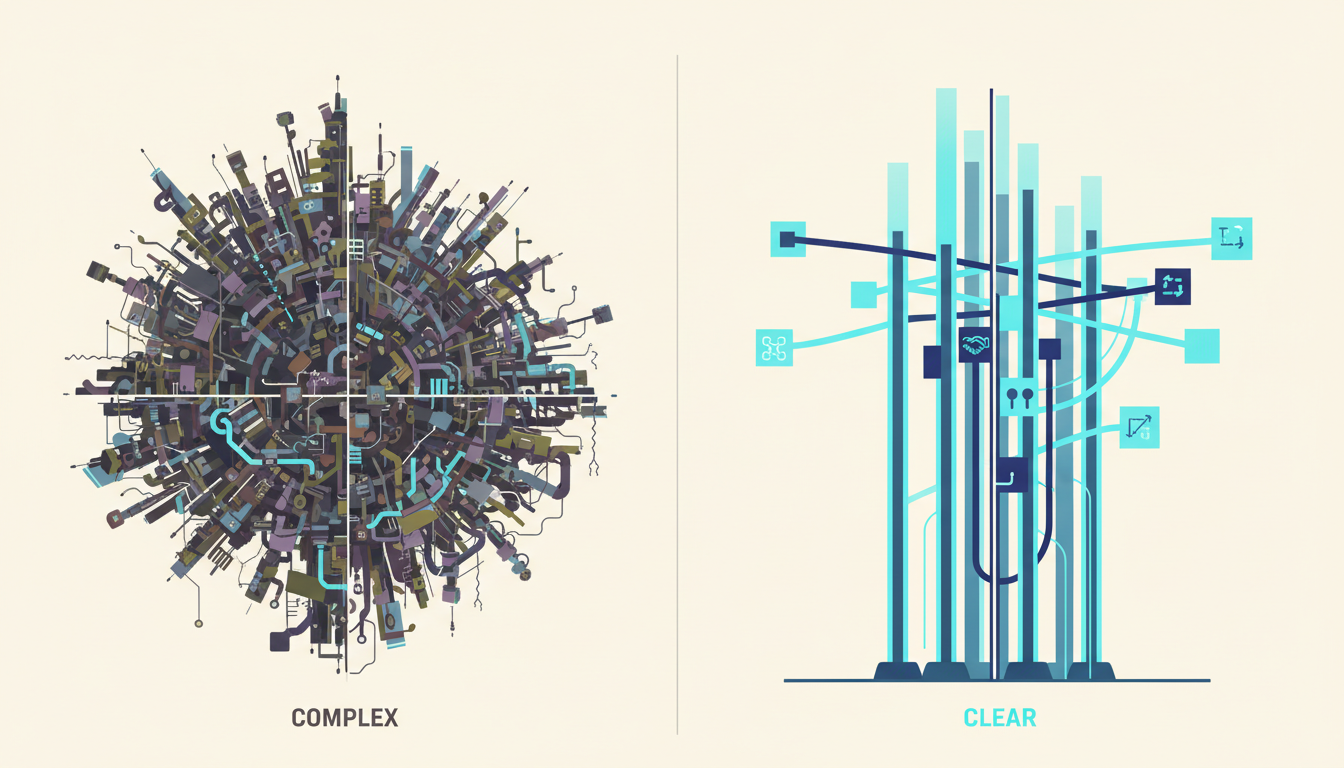
The shift from completing assignments to building with understanding transforms careers. Discover how thinking beyond today and communicating with clarity creates systems that endure.
When building technology—or any complex system—it's easy to believe that technical skill alone will guarantee success. Mastering tools, optimising performance, and solving problems quickly seem like the obvious markers of progress.
Yet over time, a deeper truth reveals itself:
The best systems, teams, and careers are not built on technical brilliance alone. They are built on clarity.
Clarity of purpose. Clarity of design. Clarity of communication.
The ability to make complexity understandable—to structure, explain, and refine ideas for others—is what determines whether work survives, grows, and inspires trust.
The Communication Shift
When improving technical or professional skills, the focus often centres on mastering new tools, optimising performance, or refining processes.
These areas are essential, but there's another skill, equally vital and often underestimated: the ability to communicate clearly.
From Following to Owning
In the early stages of a career, especially for junior developers and new professionals, work often feels like a sequence of tasks—assignments passed down by managers, supervisors, or project leads.
At first, the main focus is completing what's been asked. The urgency or broader significance behind each task may not yet be clear.
However, with experience comes a deeper understanding.
Each task is not an isolated request. It's a piece of a larger system—a project, a product, a platform—where every contribution connects to others.
What once felt like isolated instructions transforms into shared ownership.
Completing a task becomes more than checking a box; it becomes an act of sustaining momentum, protecting quality, and serving a collective vision.
How Communication Habits Evolve
As this shift from task-following to ownership grows, communication habits naturally evolve too:
- Instead of passively receiving instructions, contributors begin to seek clarity upfront
- Instead of assuming "finishing the work" is enough, they ensure their solutions are understandable, maintainable, and adaptable by others
- Instead of working in isolation, they proactively share context and reasoning
Communication as Technical Skill
Communication is not an add-on to technical work. It is how technical work becomes trustworthy, scalable, and sustainable.
Consider two developers with equal technical ability:
- Developer A writes brilliant code but leaves no documentation, uses cryptic variable names, and resists explaining their approach
- Developer B writes solid code, documents decisions, uses clear naming, and proactively explains their reasoning
Who becomes more valuable to the team? Who gets promoted? Who builds trust?
Developer B—not because they're more technically skilled, but because their work can be understood, extended, and trusted by others.
Understanding one's role in the larger system transforms the mindset from simply completing tasks to building enduring foundations.
Thinking Beyond Today
In the pressure of daily tasks and deadlines, it's natural to focus on solving only the problem right in front of us.
Common priorities often include:
- Delivering a feature
- Closing a task
- Finishing the current phase
Whilst this approach gets work done, sustainable systems—and careers—are rarely built on urgency alone.
They're shaped by those who understand that today's decisions lay the foundation for tomorrow's experiences.
The Hidden Cost of Unclear Thinking
Imagine a developer, designer, or contributor picking up a task that seems straightforward—something that should take only ten or fifteen minutes.
But once they begin, hidden complications appear:
- A term or label that lacks meaning
- A section of work whose purpose is unclear
- No explanation for a decision made months ago
- A small issue rooted in larger, unresolved system gaps
What seemed simple becomes time-consuming, not because the task is complex, but because the thinking behind it is difficult to trace.
These moments reveal a hard truth: Clarity is not optional—it protects momentum.
A More Thoughtful Approach
Now consider a different approach. Before jumping in, the contributor takes a moment to reflect.
Instead of racing to a solution, they briefly map out the issue. Options are explored. A mental plan is formed.
Even when the task appears minor, this pause makes a difference:
- Elements are clearly named
- Structure supports easy understanding
- Key decisions are either documented or made evident through design
The result is not just a quick fix—it's a meaningful improvement, created with tomorrow in mind.
Those who revisit the work later—teammates, new hires, or even the original author—step into a system that feels organised, understandable, and easy to build on.
The Compounding Effect
This habit compounds over time:
- Frustration is reduced - Future contributors don't waste hours deciphering unclear work
- Confidence grows - People trust the system because it makes sense
- Progress accelerates - Clear foundations enable faster, safer iterations
Beyond Code: Universal Principle
The same principle applies across fields:
- In engineering: Clear documentation prevents costly rework
- In design: Thoughtful structure enables seamless collaboration
- In education: Clear lesson plans help future teachers
- In leadership: Transparent decisions build team trust
- In research: Reproducible methods advance knowledge
Even in highly standardised industries like aviation, manufacturing, or compliance-heavy environments, where individual freedom may be constrained by fixed protocols, clarity still matters.
Forethought shows up in the way instructions are followed, communicated, and improved upon.
Why Clarity Protects Value
Wherever systems are built and passed on, clarity increases value:
- It supports faster onboarding
- It reduces rework and technical debt
- It preserves the reasoning behind choices, long after memories fade
- It enables confident iteration rather than fearful maintenance
That is the quiet power of clarity: a gift we offer to the future—through the care we take today.
Put It Into Practice: Building Your Clarity Foundation
Clarity isn't abstract—it's a daily practice that transforms your work and career. Here are exercises to build clarity into everything you create.
Exercise 1: The Tomorrow Test
Before finishing any work, ask:
- Will someone else understand this in 6 months?
- Will I understand this in 6 months?
- Are my variable/function/file names self-explanatory?
- Can someone follow my logic without asking me questions?
- What's the one sentence that explains why I built it this way?
Action: If the answer to any question is "no," spend 5 extra minutes adding clarity now. It will save hours later.
Exercise 2: Communication Shift Assessment
Honestly evaluate where you are:
- Task-focused: "I just do what I'm told"
- Transition: "I complete tasks but ask clarifying questions"
- Ownership: "I understand how my work fits into the bigger picture"
- Leadership: "I proactively communicate context and reasoning"
Goal: Identify your current stage and the specific habits needed to reach the next level.
Exercise 3: Clarity Audit
Review your most recent work and score it:
- Naming: Do names clearly express intent? (1-5)
- Structure: Is the organisation immediately obvious? (1-5)
- Documentation: Are key decisions explained? (1-5)
- Simplicity: Is it as simple as it could be? (1-5)
- Independence: Can someone understand it without asking you? (1-5)
Target: Average score of 4+. Anything below 3 needs immediate attention.
What's Next: From Personal to Team
Part 1 explored clarity at the personal level—how thinking beyond today and communicating with intention transforms your individual work and career trajectory.
But clarity doesn't stop at the individual level. The most powerful systems are built through conversations that align teams, through designs that favour simplicity over cleverness, and through architectures that inspire trust.
In Part 2, we explore:
- How conversations build systems before code does
- Why clarity outlasts cleverness
- How to design systems people can trust
- The leadership dimension of clarity
Because clarity isn't just about writing better code. It's about building systems that endure, adapt, and serve people—long after you've moved on.
Chapter 5: Building for Understanding
-
Current - Part 1
From Tasks to Clarity -
Coming Next - Part 2
Why Clarity Outlasts Cleverness
Master the Complete Framework
Wired for Innovation explores 15 chapters of integrated principles—from systems thinking and philosophy to career architecture and AI integration—providing a complete guide for building with clarity and lasting impact.
Get the Book on Amazon →Join the Community: Connect with fellow builders who value clarity over cleverness in our Facebook Group.
About the Author
Dr. Dotun Omosebi holds a PhD in Artificial Intelligence and Edge Computing from Edge Hill University. With decades of experience in software development, systems architecture, and AI research, he brings both technical depth and philosophical insight to understanding how technology shapes our world. Wired for Innovation is his guide for anyone navigating the frontier where technology meets humanity.