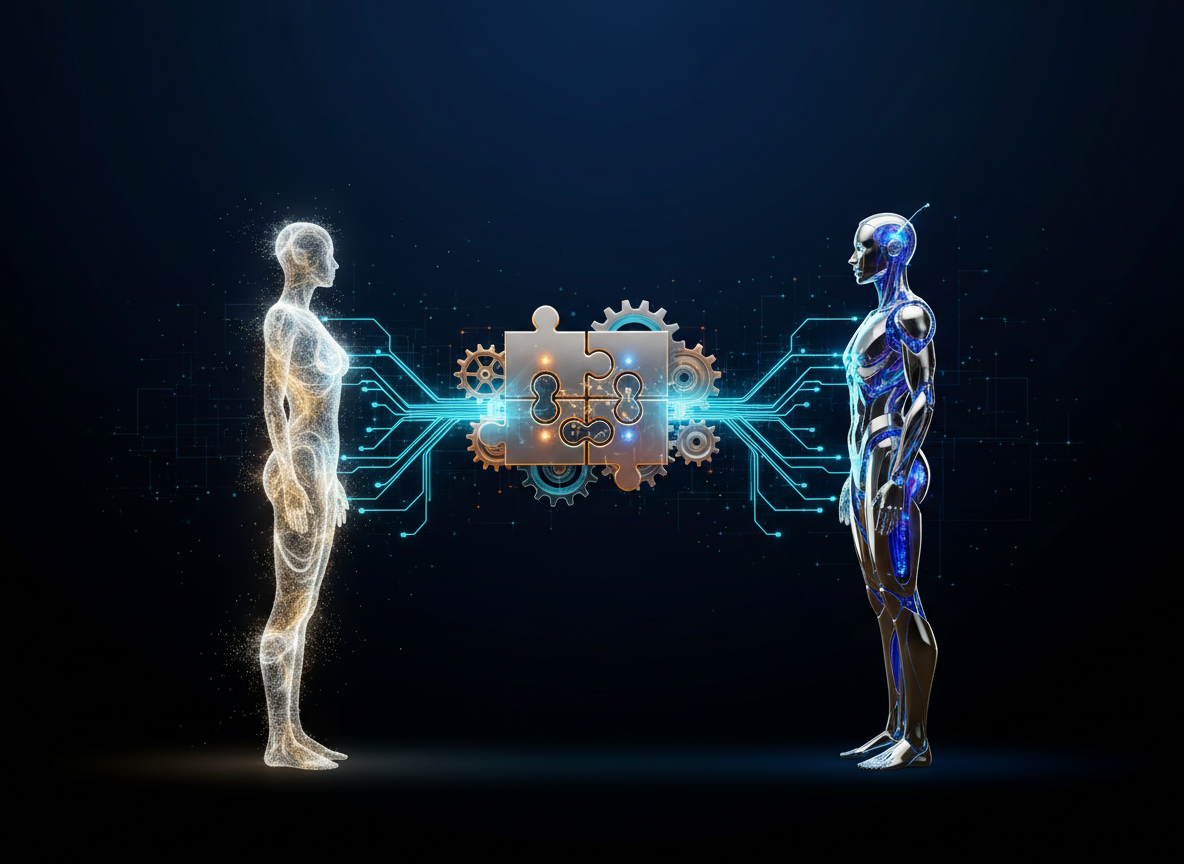
We are living through a profound shift. Learn how to work alongside AI, preserve human judgment, and understand the complementary strengths of humans and machines.
The Shift We Are Living Through
We are living through one of the most significant shifts in modern history - one that is not just changing how we work, but how we define work itself.
Just a few years ago, building software, analysing data, or drafting professional content required specialised expertise and years of training. Today, many of those same tasks can be assisted - or in some cases, fully performed - by Artificial Intelligence (AI).
This change is not just technical. It is deeply human. For professionals, creators, students, and everyday users alike, AI now plays the role of co-pilot, tutor, collaborator, and sometimes even challenger.
It rewrites how we solve problems. It changes how we learn. And most importantly, it invites us to reconsider the question: "What is our value when machines can also create?"
Understanding What Has Changed
There have been moments in history when the nature of work changed so profoundly that entire industries, habits, and expectations had to adjust. Examples include the printing press, the industrial revolution, and the internet.
We are in one of those moments again.
The Pattern of Technological Shifts
Historical Technology Transitions
- Initial anxiety: "This will replace us entirely"
- Experimental adoption: Early users discover unexpected benefits
- Skill evolution: New capabilities emerge; some old ones become less valuable
- Integration: Technology becomes infrastructure; we forget life before it
- New equilibrium: Different work, not less work
We are currently between experimental adoption and skill evolution - the period of greatest uncertainty and opportunity.
What Machines Do Best
To work effectively with AI, we must understand its genuine strengths - not the hype, but the real capabilities.
Machine Strengths
- Pattern recognition at scale: Finding patterns in massive datasets
- Consistency: Performing repetitive tasks without fatigue or variance
- Speed: Processing information far faster than humans
- Memory: Perfect recall of training data
- Availability: Operating 24/7 without breaks
AI excels at tasks that are: Well-defined, pattern-based, high-volume, and have clear right answers.
What Humans Do Best
But machines, for all their capabilities, have profound limitations. Understanding these limitations reveals where human value remains irreplaceable.
Human Strengths
Uniquely Human Capabilities
- Contextual judgment: Understanding nuance, culture, and unspoken factors
- Creative synthesis: Combining ideas in genuinely novel ways
- Ethical reasoning: Weighing values and making moral choices
- Empathy: Understanding and responding to human emotion
- Adaptation to novelty: Handling truly unprecedented situations
- Strategic thinking: Setting goals based on values and vision
Humans excel at tasks that are: Ambiguous, value-laden, context-dependent, and require wisdom rather than just intelligence.
The Partnership Model
The future is not humans versus machines. It is humans with machines - each doing what they do best, in combination creating outcomes neither could achieve alone.
Effective AI Partnership
The best outcomes emerge when we use AI to handle:
- Initial drafts and ideation
- Research and information gathering
- Routine analysis and pattern detection
- Code scaffolding and boilerplate
- Proofreading and consistency checking
While humans focus on:
- Strategic direction and goal-setting
- Quality judgment and refinement
- Contextual adaptation
- Ethical oversight
- Creative synthesis and originality
Partnership in Practice: Writing
AI role: Generate first drafts, suggest structures, check grammar
Human role: Provide voice and style, ensure accuracy, add insight, make judgment calls, connect with audience
Result: Faster production of higher-quality work than either alone
Redefining Human Value
As AI handles more routine cognitive work, human value increasingly comes from capabilities machines cannot easily replicate.
The New Premium Skills
Skills that become more valuable in an AI age:
- Asking better questions: Framing problems in useful ways
- Critical evaluation: Judging AI outputs for quality and appropriateness
- Domain expertise: Deep knowledge to guide and verify AI suggestions
- Relationship building: Human connection and trust
- Ethical judgment: Navigating grey areas and value conflicts
What to Learn, What to Let Go
Not all skills maintain equal value as technology evolves. Strategic learning means focusing effort where human advantage is sustainable.
Skills to Deepen
- Judgment and discernment: Evaluating options and making wise choices
- Systems thinking: Understanding complex interconnections
- Communication: Explaining, persuading, teaching
- Creativity: Original thinking and novel synthesis
- Empathy: Understanding and responding to human needs
Skills to Evolve
- From memorisation to curation: Knowing where to find information matters more than storing it
- From execution to direction: Guiding AI matters more than manual implementation
- From individual work to orchestration: Managing AI-human workflows
Practical Exercises: Working with AI
Exercise 1: Task Analysis
List your current work tasks. For each, identify: Is this pattern-based or judgment-based? Could AI assist? What would I still need to do? Create a partnership map showing AI role vs. human role for each task.
Exercise 2: Complementary Strengths Mapping
Choose a complex project. Map which parts play to machine strengths (speed, consistency, pattern recognition) and which parts play to human strengths (judgment, creativity, empathy). Design workflow accordingly.
Exercise 3: AI Experiment
Take a task you normally do manually. Use AI to assist. Document: What did AI do well? What did it miss? What did you add? How did the partnership change the outcome? What would you do differently next time?
Exercise 4: Skill Investment Planning
Review your skills against the "new premium skills" list. Which do you have? Which need development? Create a 6-month learning plan focused on skills that complement AI rather than compete with it.
Exercise 5: Value Proposition Update
Write your professional value proposition. What uniquely human capabilities do you bring? How do you add value that AI cannot? Update your professional narrative for an AI-augmented world.
Coming Up Next: In Part 2, we explore how to navigate the AI age practically, maintain human judgment when using AI tools, and future-proof your skills for continued relevance.