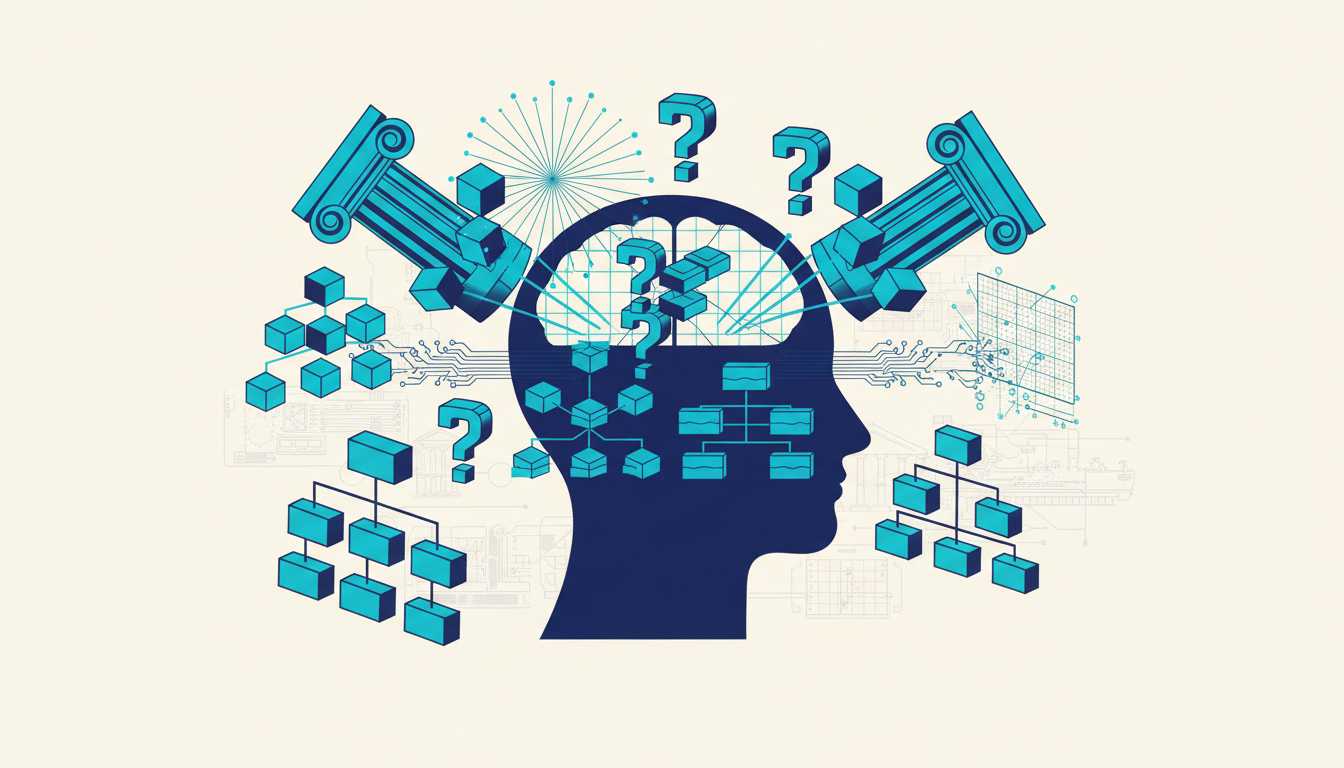
Before code, before systems, before innovation—there is thought. Discover how philosophy provides the hidden frameworks that shape how we think, build, and create lasting impact.
Behind every system, every decision, and every innovation lies a deeper structure: the architecture of thought itself.
While the technical world often emphasises frameworks, tools, and outcomes, it's the unseen disciplines of thinking and perception that ultimately determine what is built—and how well it endures.
This chapter explores how philosophy provides the invisible scaffolding for systems thinking, from ancient wisdom to modern innovation.
Discovering Thought as a Tool
Before the first line of code, before any system was designed, there was a fundamental curiosity: How do people think? And how does that thinking shape the systems they create?
The Questions That Persist
Even early on—long before databases or compilers became familiar—there was an instinct for observing systems. Not mechanical ones, but human ones.
A few quiet questions persisted:
- What drives human thought?
- What defines clarity?
- Why do some ideas endure whilst others fade?
Philosophy and psychology weren't introduced through formal study initially. They emerged organically—through books stumbled upon, through lingering conversations, and through solitary moments that demanded deeper reflection.
Knowledge as Architecture
This realisation altered the approach to learning itself. Knowledge was no longer seen as a collection of facts or achievements. It became a discipline of the mind—a structure built through:
- Questioning assumptions
- Observing complexity
- Refining insight with clarity and purpose
Philosophy offered the first glimpse of this architecture: the recognition that the mind is not a passive receiver, but an active constructor of meaning.
Psychology added another crucial dimension: the understanding that thought is rarely purely logical. It's layered with emotion, memory, bias, and unseen motivations.
Systems Beyond Code
Among the most exciting discoveries within psychology was the study of body language—an often-overlooked system of communication.
Body language revealed that beyond spoken words, there exists an entire layer of meaning conveyed through posture, gesture, and subtle expressions. It demonstrated that even in silence, individuals are continuously participating in a rich, complex dialogue—often without conscious awareness.
This deepened understanding: Communication is not merely verbal or written; it's systemic, multi-layered, and profoundly human.
Descartes and the Coordinates of the Mind
When philosophy is mentioned, it often evokes images of abstract debates or distant ancient wisdom. Yet some of the most important contributions to modern systems came from a philosopher who was also a mathematician: René Descartes.
The Cartesian Revolution
Descartes is often referred to as the father of modern philosophy, but his influence extends far beyond philosophical discourse. One of his most enduring contributions is the Cartesian coordinate system—a concept encountered by virtually everyone at some point.
The Cartesian system—using two or more axes to describe position—revolutionised mathematics, science, and engineering. Without it, much of modern life would be unrecognisable:
- Graphs and data visualisation
- Computer graphics and 3D games
- GPS navigation
- Architectural design
- Virtual simulations and VR
- Autonomous vehicles
Any domain where objects move, align, or interact in space—from city planning to robotics—carries a quiet debt to Descartes' vision.
From Philosophy to 3D Graphics
In 3D graphics, every object's position is defined by coordinates (x, y, and z)—each representing width, height, and depth within a spatial system.
This extension into three dimensions allows not just surfaces but entire volumes to be mapped, navigated, and manipulated with precision. Every 3D model sculpted, every animated world designed, rests quietly on the principle that space—both physical and abstract—can be organised into measurable frameworks.
"I Think, Therefore I Am"
Descartes' philosophical insight is equally profound. His famous assertion, "Cogito, ergo sum"—"I think, therefore I am"—remains one of the most powerful statements in intellectual history.
It shifts the basis of human identity away from tradition, status, or circumstance, and centres it within thought itself. Existence, it suggests, is validated not by external markers, but by the act of conscious reflection.
Descartes' contribution is twofold: a philosophical insight (thinking as active construction) and a mathematical framework (organising complexity into navigable dimensions).
The Legacy: Mapping Complexity
Beyond technology, Descartes offers an even deeper lesson:
Complexity can be conquered not through brute force, but through building frameworks that bring clarity to the unseen.
True understanding is not a luxury reserved for rare moments, but a necessary foundation for innovation and enduring success.
Lessons from the Philosophical Toolbox
As growth unfolded—both in constructing systems and in understanding human behaviour—it became increasingly evident that the early philosophers were, in many respects, the world's first systems architects.
Though they didn't write code or design physical systems, they built enduring frameworks for structured thought, ethical reasoning, and the pursuit of lifelong learning.
Aristotle: The Power of Categorisation
From Aristotle emerged the power of categorisation. His systematic method of organising knowledge into causes, purposes, and principles mirrors the foundational work of:
- Modelling complex data
- Designing modular systems
- Bringing structure to chaos
In an era saturated with information, Aristotle's legacy serves as a reminder: Structure reveals meaning. Without clear categorisation, even the most valuable knowledge can devolve into noise.
Aristotelian Structure in Modern Systems
When you organise files into folders, when you design database schemas, when you create taxonomies—you're using Aristotelian thinking. The ability to categorise complexity into meaningful groups is foundational to all systems design.
Socrates: The Art of Questioning
The influence of Socrates proved even more profound—not through the provision of answers, but through the refinement of questions.
His belief that wisdom begins with the acknowledgement of one's own ignorance became a guiding principle in technical design, systems analysis, leadership, and decision-making.
The method of Socratic questioning became a silent yet powerful discipline:
- Challenging assumptions
- Interrogating the obvious
- Remaining genuinely curious even when a solution appears certain
Freud: Trusting the Unconscious
From Sigmund Freud came an unexpected contribution. Whilst aspects of his psychoanalytic theories continue to invite debate, one idea resonated deeply:
Unconscious processes play an essential role in learning and problem-solving.
The conscious mind engages actively with new information, but when given time and space, the subconscious continues the work in the background.
This insight aligned with personal experience: when faced with complex or elusive ideas, forcing comprehension was often counterproductive. Instead, stepping away, allowing the mind to rest and reorganise, often led to greater clarity upon return.
Learning is not confined solely to active effort; it continues quietly beneath awareness when given patience and trust.
Philosophy as Practical Toolbox
Philosophy didn't remain abstract or detached from technical mastery. It became a practical toolbox for structured thinking and personal growth:
- The discipline to categorise complexity before attempting resolution (Aristotle)
- The wisdom to question assumptions as a fundamental step in decision-making (Socrates)
- The trust in unseen, subconscious processes that deepen true understanding over time (Freud)
- The framework to map complexity into navigable dimensions (Descartes)
These lessons shaped not merely external systems, but the internal architecture of thought itself—the mind that observes, questions, designs, and ultimately determines the course of creation and growth.
Put It Into Practice: Building Your Philosophical Foundation
Philosophy isn't just for academics—it's a practical discipline that sharpens how you think, build, and innovate. Here are exercises to develop your philosophical thinking.
Exercise 1: Socratic Assumption Mapping
Choose a current project or decision and ask the Socratic questions:
- What am I assuming to be true?
- Why do I believe this assumption holds?
- What evidence supports or contradicts it?
- What happens if this assumption is wrong?
- What question am I not asking?
Insight: Most failures stem from unexamined assumptions. Socratic questioning reveals them before they become problems.
Exercise 2: Aristotelian Complexity Categorisation
Take a complex problem you're facing. Break it down using Aristotelian categorisation:
- What is it? (Definition and essence)
- What caused it? (Root causes)
- What's its purpose? (Why does it exist?)
- What patterns does it follow? (Recurring themes)
- How can it be grouped? (Related categories)
Action: Create a taxonomy of the problem. Structure reveals solutions.
Exercise 3: Cartesian Framework Mapping
Map a complex challenge using Cartesian coordinates:
- X-axis: Immediate vs. Long-term impact
- Y-axis: Easy vs. Difficult to implement
- Plot your options or tasks on this grid
- Identify high-value, low-effort opportunities
- Create a strategic sequence
Insight: Spatial frameworks make abstract priorities concrete and actionable.
Exercise 4: Freudian Subconscious Processing
When stuck on a difficult problem:
- Spend 30 minutes deeply engaging with it
- Document what you know and don't know
- Then completely step away for 24-48 hours
- Do something completely different
- Return fresh and see what clarity emerges
Principle: Trust your subconscious to process complexity whilst you rest. Forcing solutions often blocks them.
Exercise 5: Philosophical Reflection Journal
Weekly practice: Spend 15 minutes answering:
- What assumption did I discover this week?
- What question changed my thinking?
- What complexity did I successfully categorise?
- Where did stepping back bring clarity?
- What framework helped me see differently?
Goal: Build metacognition—awareness of how you think. This is where mastery lives.
What's Next: From Philosophy to Psychology
Philosophy provides the frameworks for thinking. But how does that thinking manifest when we actually build, create, and collaborate with others?
In Part 2, we explore how psychology shapes what we create:
- How emotions and beliefs invisibly influence systems
- Why building for people requires understanding people
- How the creator's mindset becomes the foundation of creation
- What empathy in design truly means
Because true innovation doesn't just require clear thinking—it requires understanding the human mind behind the work.
Chapter 4: The Mind Behind the Method
-
Current - Part 1
Philosophy Meets Systems Thinking -
Coming Next - Part 2
Psychology of Building and Creating
Master the Complete Framework
Wired for Innovation integrates philosophy, psychology, systems thinking, and practical innovation into a comprehensive guide for building with clarity, empathy, and lasting impact.
Get the Book on Amazon →Join the Community: Connect with fellow thinkers and builders in our Facebook Group.
About the Author
Dr. Dotun Omosebi holds a PhD in Artificial Intelligence and Edge Computing from Edge Hill University. With decades of experience in software development, systems architecture, and AI research, he brings both technical depth and philosophical insight to understanding how technology shapes our world. Wired for Innovation is his guide for anyone navigating the frontier where technology meets humanity.