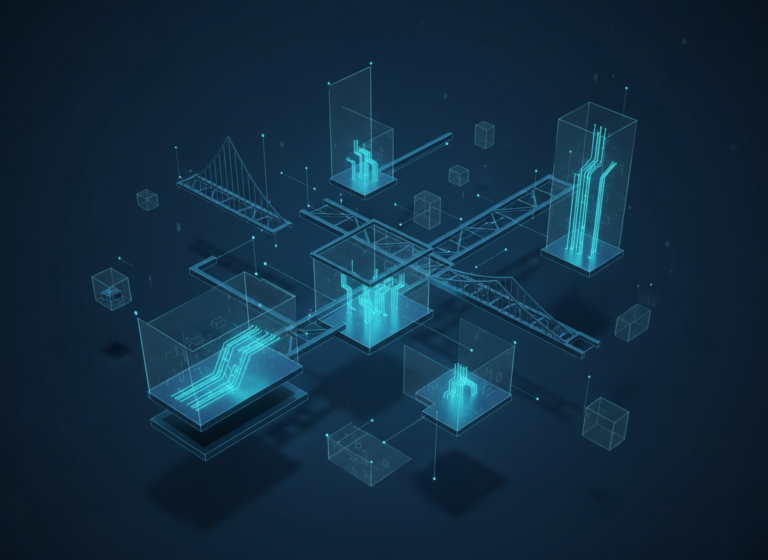
When Code Becomes Architecture
Learn why software architecture matters, how to design systems that can grow without breaking, and the human side of building technology that endures.
When Good Code Creates Fragile Systems
In the previous section, we looked at the shift that happens when code stops being just a set of instructions - and starts becoming part of a real experience for real people. But there is another shift that follows soon after.
It arrives when you realise that even good code - clean, efficient, functional - can become part of a mess if the structure around it is not carefully shaped.
Critical Realisation: This is when the idea of software architecture begins to matter. Not as something formal or theoretical, but as a response to a very practical problem: things start breaking when they are not designed to work together.
The Connected System Problem
Consider a project that involved several connected parts: a login system, billing, email notifications, and usage reporting. Each feature worked well when tested alone. But once they were connected, issues began to emerge.
A change in one area triggered failures in another. Fixing one piece broke another. Updates became stressful. Testing was slow. The whole thing felt unstable.
What Went Wrong?
- Individual Parts: Well-written and functional
- System Structure: None - pieces were simply connected
- Result: Fragile, unpredictable, difficult to maintain
- Root Cause: No architectural thinking
Without intending to, we had built something fragile. Not because the individual parts were poorly written - but because the system had no guiding structure.
The Lesson: If you do not design a structure, one will still form. But it may not be one you can live with.
The House Renovation Analogy
It is a bit like renovating a house room by room - without planning where the plumbing goes or how the wiring connects. The kitchen looks great. The bathroom works. But then you plug in a heater and turn on the kettle, and suddenly the lights go out.
The issue was not in any one room. It was in how they were connected.
Software systems are no different. As they grow, the invisible links between parts become just as important as the parts themselves.
Architectural Thinking
This is where architectural thinking steps in. It does not mean adding complexity. It means asking smarter questions early enough to shape what comes next:
- How should information move between parts?
- What can be separated to make updates easier later?
- What happens if something fails?
- Can someone else step in and understand how this works?
Architecture Definition: Architecture is about guiding relationships, not just building features. It is what allows a system to grow without growing unstable. It is how teams maintain confidence - even as the codebase expands and evolves.
Key Architectural Principles
Experienced developers rely on a few core architectural principles:
Separation of Concerns
Keep different responsibilities in different places. User interface logic should not be mixed with database logic. Business rules should not be tangled with presentation code.
Loose Coupling
Parts should be able to change independently. If changing one component requires changing five others, they are too tightly coupled.
Clear Boundaries
Define explicit interfaces between components. What goes in? What comes out? What assumptions can be made?
Single Responsibility
Each component should do one thing well. If a module handles authentication AND email AND logging, it is doing too much.
Leadership Through Design
Leadership in software development does not always begin with a title, a directive, or formal authority. More often, it emerges quietly - through the care taken in structure, the clarity of organisation, and the design choices that shape how others engage with a system.
Code as Communication
The way code is written, structured, and named plays a role far beyond functionality. It determines whether future contributors feel welcomed or discouraged, whether progress accelerates or stalls.
A well-structured design does not just fulfil requirements; it invites collaboration, reduces confusion, and enables growth.
Quiet Leadership: This became especially clear during a project inherited midway through its development. The codebase had evolved into a fragile maze - functional, but increasingly brittle. What it needed was not another layer of features. It needed clarity.
The Restoration Process
The real work began - not with innovation, but with restoration:
- Functions were renamed to reflect purpose rather than implementation
- Logic was grouped into coherent, modular units
- Comments were added not only to describe actions, but to explain decisions
- Documentation was rewritten to guide and encourage, not to confuse or repel
The transformation was gradual, but visible. Confidence returned. Contributions increased. The project became more than a functioning system - it became a shared space people were willing to enter and extend.
Design as Leadership: Design is not just technical. It is relational. It communicates intentions without conversation. It enables alignment without instruction. And in doing so, it becomes a form of leadership.
The Human Side of Systems
In discussions about systems, attention often gravitates toward architecture diagrams, data flows, interface specifications, and optimisation techniques. It is easy to become immersed in abstraction.
Yet behind every system, beneath each line of code, rests a simple and often forgotten truth:
Systems are built by people, used by people, and maintained by people. And people are not abstract. They are emotional, fallible, creative, and deeply influenced by how a system makes them feel - not just how it performs.
When Systems Fail People
Some of the most technically impressive systems have failed - not because of flawed logic, but because they neglected the people they were meant to serve. Others have been quietly abandoned by their own teams, not due to complexity, but because the system became burdensome, isolating, or needlessly obscure.
At such moments, it becomes evident that functionality alone is not enough. Systems must be humane.
Building Humane Systems
To build humane systems is to go beyond performance metrics and scalability targets. It is to consider how a tool invites use, how it supports learning, and how it earns trust.
Thoughtful development considers:
- Whether the tools being created are intuitive and satisfying to use
- Whether new contributors are welcomed through clear, supportive onboarding
- Whether documentation informs rather than intimidates
- Whether decisions are communicated with transparency and respect
Internal Systems Matter Too: Many projects have faltered not because the code was broken, but because the team around the code broke first. Feedback loops disappeared. Communication grew strained. Morale declined - even as the codebase appeared stable.
Design for Change
If there is one principle that remains constant in the world of software development, it is this: everything changes.
Requirements shift. Teams evolve. Technologies advance. Tools become obsolete. What works reliably today may introduce friction tomorrow.
The Maturity Shift
For those early in their journey, change feels like an interruption. The instinct is to finish the work, seal it off, and move on. After all, once something is "done," it should remain done.
With time and experience, however, a more enduring insight emerges: the best systems are not those that resist change. They are the ones that anticipate it.
Mature systems are not built with permanence. They are built with space - space to adapt, grow, and absorb new conditions without collapsing.
Questions for Flexible Design
Designing with change in mind requires a different kind of question set:
- What happens when this feature is no longer needed?
- How easily can this be extended or adjusted without breaking something else?
- Will a new developer, unfamiliar with the system, be able to understand what has been built?
This is not a call to over-engineer a system. It is a call to build in some breathing room.
Practical Flexibility
- Leave certain decisions open-ended
- Document reasoning behind designs, not just results
- Choose simplicity to preserve future options
- Isolate fragile logic
- Version interfaces
- Write comments as guides to future maintainers
Functionality and Flexibility
Eventually, this mindset becomes second nature. Developers begin to scaffold systems rather than seal them shut. In doing so, the system gains its most valuable asset: functionality and flexibility combined.
Good systems deliver what is needed now. Great systems remain ready - long after the original hands have left the keyboard.
Practical Exercises: Architectural Thinking
Exercise 6: System Fragility Audit
Examine a current system you work with. Where are the fragile points? What breaks when you change one thing? Map the dependencies and identify where better architecture would help.
Exercise 7: Architectural Principles Application
Choose one component in your system. Apply the four principles: (1) Is it focused on one responsibility? (2) Is it loosely coupled? (3) Does it have clear boundaries? (4) Are concerns properly separated? Redesign if needed.
Exercise 8: Code as Leadership
Review code you have written recently. Does it invite collaboration or discourage it? Would a new developer feel welcomed or confused? What would you change to make it more welcoming?
Exercise 9: Humane System Assessment
Evaluate a system from a human perspective. Is it satisfying to use? Does documentation inform or intimidate? Do error messages help or confuse? Create a plan to make it more humane.
Exercise 10: Change Readiness
Imagine your current system needs a major feature change. What would break? What would be easy to modify? Where did you build in flexibility? Where did you seal things shut? Design improvements for better change readiness.
Chapter Summary: Good code is not enough - systems need thoughtful architecture. Architecture guides relationships between components, enabling growth without instability. Design choices communicate intent and invite collaboration, making them a form of leadership. Humane systems consider not just functionality but how people feel using and maintaining them. The best systems are built with flexibility, anticipating change rather than resisting it.